
Lorem ipsum dolor sit amet, consetetur sadipscing elitr, sed diam nonumyert et eirmod tempor invidunt ut labore et ert dolore magna aliquyam erat, sed diam voluptua. At vero eos et accusam et cer justo duo dolores et berr ea rebum. Stet clita kasd gubergren, no sea takimata sanctus est Lorem ipsum dolor.
Appilo comes with a beautiful collection of modern, easily importable, and highly customizable demo layouts.
The AGB Education Academy programs are delivered 100% online. The curriculum is structured around short, 30-40 hour interactive learning modules that are set against RQF (Regulated Qualifications Framework) learning outcomes. Students receive additional resources to aid learning, such as ebooks, webinars, and one-to-one dedicated tutor support, all of which are free of charge as part of the program. Assessment for the modules involves an online multiple-choice assessment consisting of 30 questions with a pass mark of 50%. Upon the successful completion of all modules, students are required to write assignments set by the awarding body to receive their diploma. This diploma can then be used as University credits. The programs are offered completely off campus and provide agreed-upon top-up routes to a variety of UK universities. AGB Education Academy works with OFQUAL approved partners.
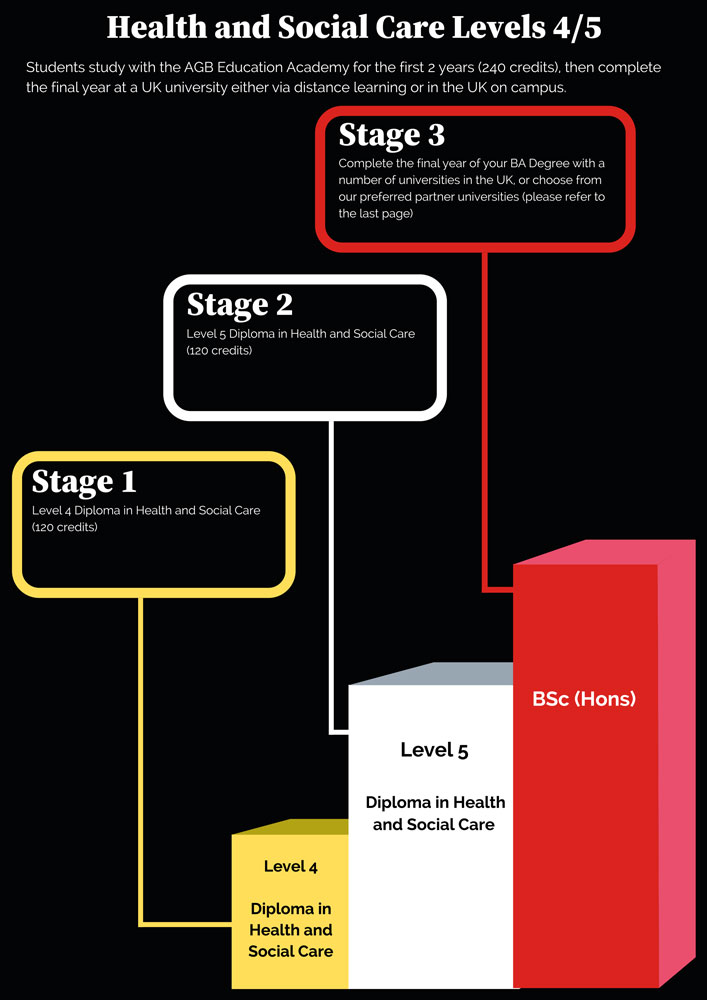
The undergraduate level 4/5 health and social care course is a 240 credit course designed to fast track students to the final year of an associated undergraduate degree within the health and social care sector. The final year top up degree can be completed at a UK university on campus or via distance learning.
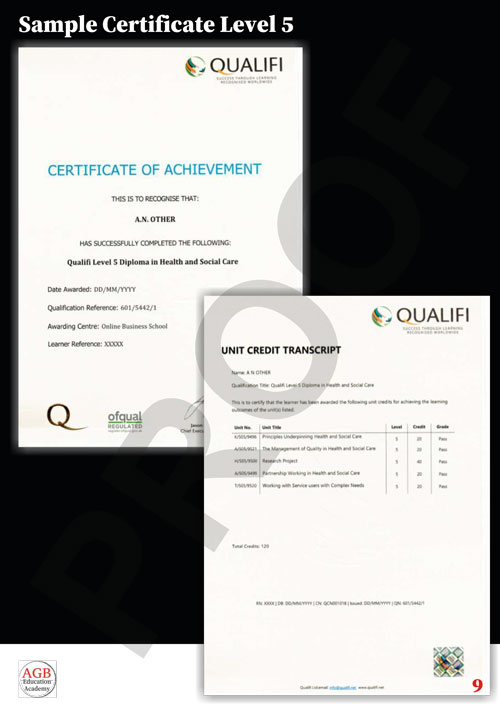
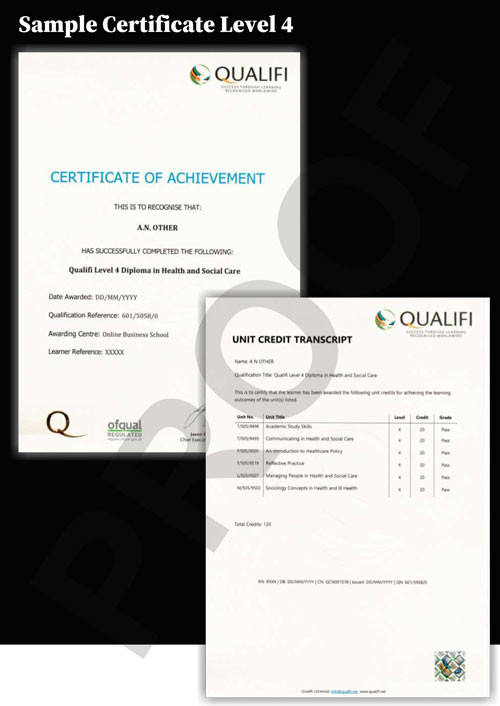
The course is made up of six level 4 modules and assignments (120 credits) and five level 5 modules and assignments (120 credits).
Each module consists of approximately 40 guided learning hours of material with an additional 30-50 hours of optional learning material. These materials comprise recommended exercises, recommended readings, and internet resources
There are no specific ‘enrolment dates’; students are able to start and finish the course at a time and date that suits them
The aim of this module is to enable learners to develop the necessary skills and understanding to study effectively within higher education. This will enable learners to acquire the necessary reflective and critical thinking skills required to achieve individual learning potential.
The aim of this module is to develop the learner’s awareness of different forms of communication used in health and social care settings and its importance for effective service delivery.
The aim of this module is to develop the learners awareness of different influences on healthcare and their effect on the development of policy. Evaluation of healthcare policy will allow learners to examine what are the key contemporary issues for those making policy, providers and those receiving support.
This module is designed to introduce the learner to reflective practice in all its forms. Reflections on practice and in practice are important concepts in health and social care and feed into the idea of self-development linking theory to practice.
The aim of this module is to enable learners to understand the processes involved in the recruitment, management and development of people in the health and social care workplace.
The aim of this module is for learners to gain an understanding of sociological concepts of health and ill health and their application to care practice in health and social care. It will enable learners to gain an understanding of the nature of contemporary society and its influences on the perception of health and ill health.
The level 4 diploma in Health and Social Care has 6 written assignments. The assignments are approximately 2,000-3,000 words each. Students are provided support on the modules and assignments via the ‘Tutor’ section of the learning platform.
The aim of this module is to develop understanding of the values, theories, and policies underpinning health and social care practice and the mechanisms that exist to promote good practice within the sector. All Health and Social care professionals have professional codes of conduct.
The aim of this module is for learners to develop an understanding of different perspectives on health and social care service quality and how it is evaluated in order to empower and involve users of services.
This module aims to develop the learners skills of independent enquiry and critical analysis by undertaking a small pilot investigation of direct relevance to their higher education programme or professional development.
The aim of this module is to enable learners to develop an understanding of the importance of working positively in partnership with others in health and social care. Learners will explore the nature of partnership on three levels:
The aim of this unit is to help learners to understand issues of health, disability and illness and how health care professionals can empower those with complex physical and mental health needs to determine their own care.
The level 5 diploma in Health and Social Care has 5 written assignments. The assignments are approximately 2,000-3,000 words each. Students are provided support on the modules and assignments via the ‘Tutor’ section of the learning platform.


Students are provided the online modules and assignments at the start of their programme. These materials contain the titles and tasks of the assignments and are made available to students for 5 years.
If a student fails the assignment, they receive feedback on the areas that need improving and are allowed to resubmit the assignment free of charge
Graduating AGB Education Academy students can progress onto a university programme either to join at undergraduate entry level, usually upon completion of a Level 3 programme, or onto a “top-up” degree, depending on the level of their completed Ofqual programme.
Generally, the UK qualification equivalency levels are: Level 3 is undergraduate entry, Level 4 is the first year of a degree, Level 5 is the second year of a degree, Level 6 is Graduate level, Level 7 is Post Graduate level.
University top-up courses require you to have a qualification in a relevant subject. The chosen course of study should be closely tied to your previous qualification, though it does not have to be the exact same subject. This offers wide flexibility, providing graduates from AGB Education courses a broad range of career or completion prospects. Universities will generally consider your broader experiences and motivations as well as your formal qualifications.
Completion of your AGB Education academy Diploma, you will be eligible to complete a university top-up programme from one of their university partners. Your final degree will be awarded by your chosen University and will not state that it has been completed online.


Contact
Ready to elevate your career? Enroll now and start your journey with AGB Education Academy today. Your qualification—and your future—starts here.
AGB Education Academy provides students with multiple support systems throughout their learning journey, all accessible through the student dashboard. These include periodically created blogs relevant to students and courses, access to live webinars along with a bank of previously recorded lessons, and an extensive library of online e-books covering a wide range of subjects. Students can also engage in interactive forums to connect with peers, ask questions, or share useful resources. Dedicated tutors are available for personal online tutoring sessions, while a regularly updated bank of external resource links offers additional learning support. Multiple-choice online tests within the modules help students assess their own learning, and student advisers are available via telephone, email, or online chat to answer queries related to learning or technical difficulties.